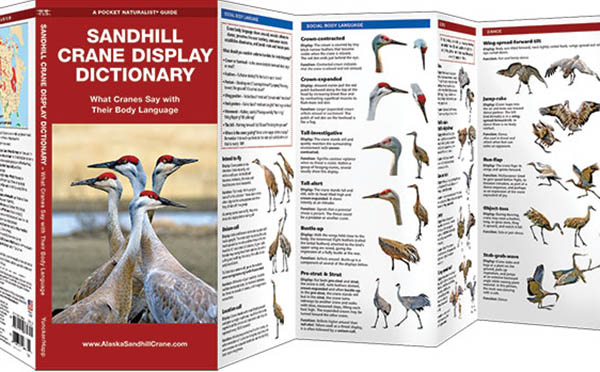
If you have looked at the Sandhill Crane Display Dictionary (Pocket Naturalist Guide) and want more information, please go to Threat and Attack Displays, Dance Displays, and Social Displays.
The sandhill cranes who nest on our cranberry bog inspired us to create this website. We feature Millie and Roy, wild sandhill cranes who fledged eight colts. Over 21 summers (1996-2016), our relationship remained respectful (100-1500 feet of separation) as we studied each other. read more/less...
Millie and Roy kept track of our habits. They took little notice of every-day barking at sleddog dinner-time yet cued off alarm yelps when a predator was in the neighborhood. They ignored the noisy truck that brought weekly water deliveries but the fuel-oil truck that came once a summer triggered caution. They were accustomed to my opening the deck door to poke the long lens through the screen curtain...except during mating.
Likewise we came to know their patterns: excited dancing on the icy pond after arrival each spring, nesting, coaching each year's colts to forage, to dance, to fly, and to dodge dangers, and leading family excursions to neighboring ponds when fall departure neared.
My notes and images provide a continuous record of successive nesting seasons of this pair of cranes. We believe that this 22 year chronicle, based on over 15,000 hours of close observation, can be viewed as a longitudinal study of nesting and nuturing. It is told from a personal point of view, yet the camera keeps it true.
In the summer seasons since Millie and Roy, several other crane families have vied for the territory. Because we knew Millie and Roy so very well, we can now see stiking and consistent differences in demeanor among the individual birds who have followed after them. The unique personalities of the birds suggest impressive capabilities of their minds.
Visitors to this website may have insights from their own perspectives. Please email your comments and especially send stories about other cranes raising their colts.
Christy Yuncker Happ

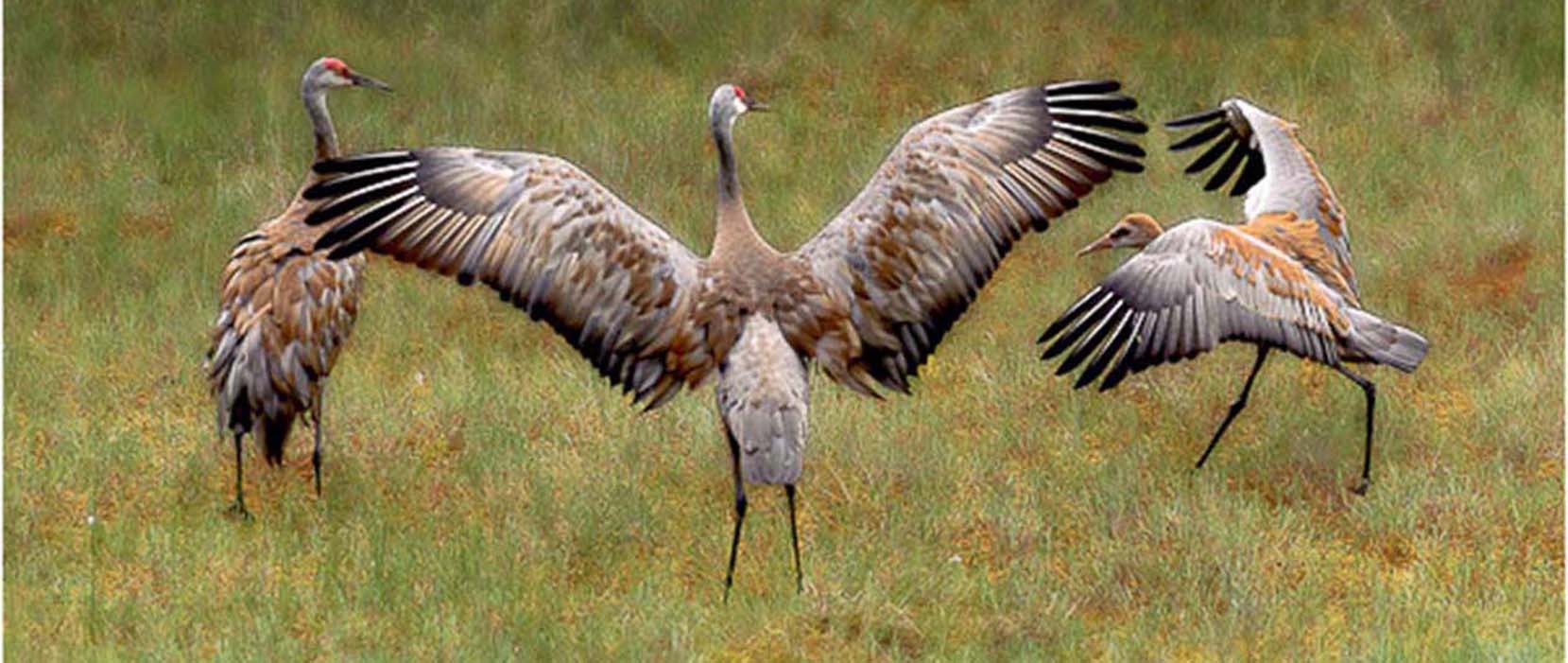
Spectacular leaps, jumps, body slams, and bill stabs are effective against predators and against other cranes competing for personal space, nest territories, or mates.

As male-female pairs dance, their movements promote and strengthen the pair bond. Reciprocal postures, refined by years of practice, synchronize emotions.

Cranes signal intent and emotion through body language. This photo shows amassing cranes, peering in every direction and presenting the Tall Alert display, as an eagle cruised overhead.
The cranes inspect their familiar territory, celebrating with unison calls and dance. Next, they cross the valley to check out the neighborhood. In the afternoon, they return to forage, to snooze, and to mate.
Millie and Roy track flying dragonflies, lunging at many and plucking some from the air for Pi-13's lunch. In the second month, Pi fixates on dragonflies, but snatching is beyond his skill-level.
The parents prompt and reward their colt. Ground school includes wing-waving, run-flapping, and energetic leaping to catch air. Once she fledges, they tutor Pi to learn in-flight social signals.
When ducks scream, Millie & Roy attack in bog central, chase a fox into the underbrush. They stalk through alders and grasses until the fox exits the vicinity.
From the day of hatch and through the entire summer, the colts dance with their parents, building motor coordination and strengthing flight muscles.
Once fledged, the colt is ushered on tours across the valley that culminate in migration, first east through the Tintana Trench, and then south to western Texas.
We live on 40 acreas of permafrost near Fairbanks, Alaska.
For 26 years, has recorded the passing of the seasons in her journals, still images, and videos.
George Happ maintains this website and the Alaska Sandhill Crane blog.