

Roy and Millie's neighborhood
A portion of Goldstream Valley in Google view (North is at the top.)

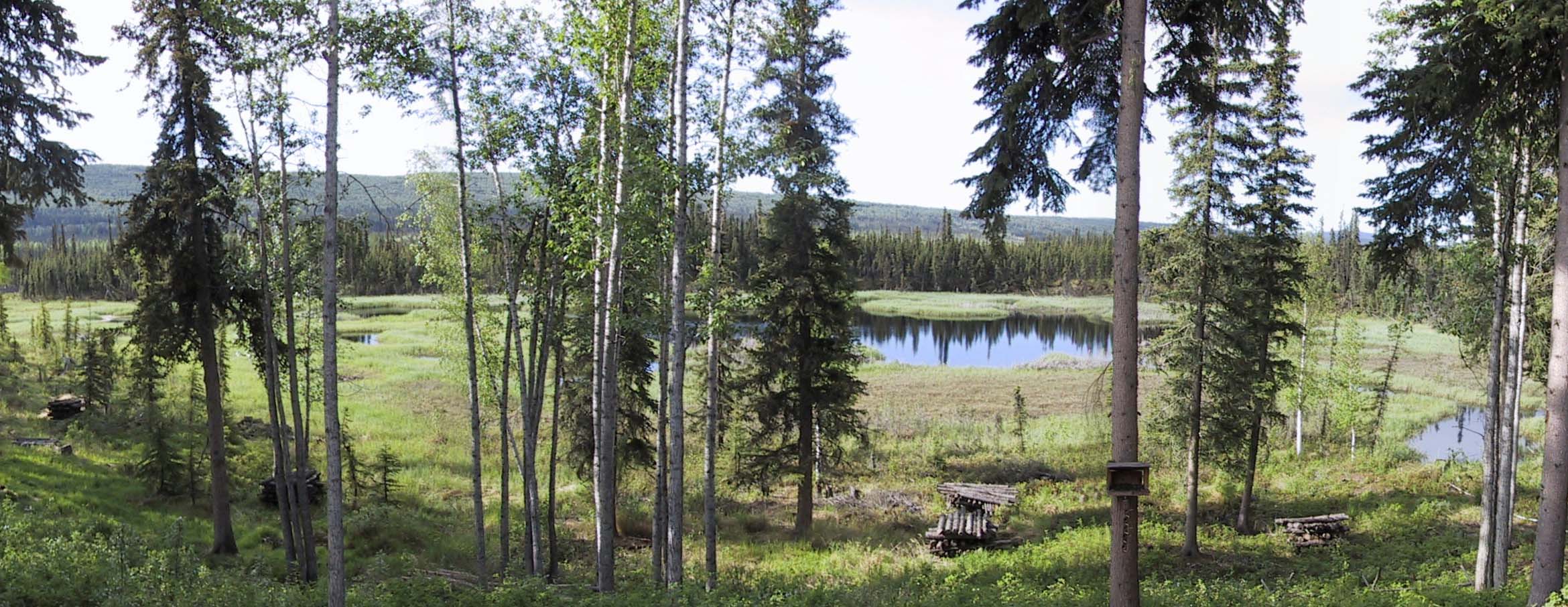
The nest territory, looking south from our house - May 11, 2000.

A portion of Goldstream Valley in Google view (North is at the top.)
- The floor of Goldstream Valley is permafrost, marsh, and tiaga.
- Several crane pairs nest in bogs in the valley.
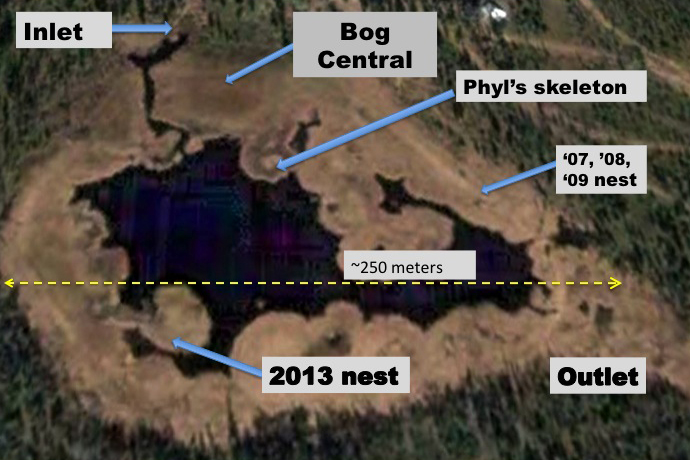
- The pond is bordered by marsh and bog which is surrounded by black spruce tiaga forest.
- The pond was formed by the collapse of an ice lens (see " Pingo" in Wikipedia).
The nest territory, looking south from our house - May 11, 2000.
- Incubation usually begins around May 4. The eggs hatch in 30-31 days. In 2000, the pond was ice-covered for the first two weeks of incubation.
- Roy and Millie usually return at the end of April when the pond is still frozen and snowpatches persist on the bog.
- The first week back is devoted to inspection of potential nest sites around the pond as well as short walkabouts (less than 1 km) into the surrounding taiga.
- Bog-Central is beyond the woodpile in the right center of the photo.
The nest territory - June 11, 2000
- Colts hatch in early June. For 13 weeks after the eggs hatch, both parents are occupied with care and education of the colt(s).
- The marsh bordering the pond is squishy sphagnum/sedge/grass/cattail.
- Bog-Central is covered with high-bush cranberry and therefore the best surface for dancing, running, and preflight run-flap coaching.
- Nightime temperatures dip below freezing in late August, and the family leaves for migration in the first days of September.
Photo Galleries
Latest Galleries
• 1 - Reclaiming the Homestead
• 2 - Incubation Month
• 3 - Fitness and Foraging
• 4 - Dodging dangers
• 5 - Chasing the fox
• 6 - Run, Flap & Catch Air
• 2 - Incubation Month
• 3 - Fitness and Foraging
• 4 - Dodging dangers
• 5 - Chasing the fox
• 6 - Run, Flap & Catch Air
• 1 - Arrival
• 2 - First week
• 3 - Incubation
• 4 - Roy's ice dancing
• 5 - Pi hatches
• 6 - Pi dances
• 7 - Dodging Danger
• 8 - Dragonflies
• 9 - Fitness for flight
• 10 - Swim with Dad
• 11 - Dance and fly
• 12 - August flight school
• 13 - Foraging and intruders
• 14 - Pi explores his world
• 15- -Time to migrate
• 2 - First week
• 3 - Incubation
• 4 - Roy's ice dancing
• 5 - Pi hatches
• 6 - Pi dances
• 7 - Dodging Danger
• 8 - Dragonflies
• 9 - Fitness for flight
• 10 - Swim with Dad
• 11 - Dance and fly
• 12 - August flight school
• 13 - Foraging and intruders
• 14 - Pi explores his world
• 15- -Time to migrate
Roy and Millie dancing
Colts of Millie and Roy
Education of crane colts
Crane biology
Hawks, owls, and eagles
Other birds
Mammals
=================


