The first hatch was in 2002 and again in 2003, but the tiny hatchlings disappeared in the first two weeks.
Although two eggs hatched in 2004, 2006, 2009, and 2010, only one hatchling survived through the summer to migrate south with Roy & Millie.
Twin crane colts are often observed in the early summer on nest territories, but twins are less common in the fall on migratory staging areas. To explain the loss of the second hatchling, many biologists have suggested siblicide. In eagles, sibling fighting is commonly observed and often the larger stronger eaglet dispatches the weaker one.
We think the inference drawn from eagle biology is not appropriate for cranes. Death of one of Millie and Roy's colts was never corrrelated with bullying. When a crane colt died, it was upsetting to the crane family. Likewise James Layne, who studied nesting cranes day-by-day through an entire field season in Florida, saw no sustained in-fighting between twin colts.
Our search of the scientific literature has yielded no direct observations of Sandhill colt siblicide in nature. There are well-documented reports of colts killing one another in wildlife farms, where crane eggs are hatched in an incubator and the colts raised packed together(like baby chickens) in dense flocks. But such hatchery flocks of crane colts are unnatural. In the wild, crane colts are singlets or in pairs.
In the absence of direct evidence of siblicide in the wild, we doubt that crane siblicide is common in nature. If you have seen crane siblicide in the wild, please email us. We will distribute your report on this website.
In the summers from 1996 through 1998, we noticed two cranes feeding around the pond and defending the nest territory from other intruding cranes. In 1999 and 2000, cranes were present for a week or more but we saw no nest.
In 2001, a pair of cranes (perhaps Millie and Roy) made a nest in early May. They were chased off by a fox on June 10 and abandoned the nest (perhaps plundered by the fox). The cranes remained at the pond for most of the summer. They were dive-bombed mercilessly by several pairs of nesting mew gulls and wandering Bonaparte's gulls.
In 2002, the pair erturned in early May and nested. A face-off between crane and fox took place in mid-May. Nest defense was successful that year, since we spotted a small crane colt in mid-June. The Mew Gulls and Bonaparte's Gulls harassed the crane family as they wandered about the marsh. At the end of June, the colt had disappeared.
In 2003, a colt survived long enough to develop wing feathers and a bustle, and to flap its wings as it ran about. In early August, the colt disappeared.
In 2004, Christy began to keep a diary of daily observations and to photograph daily the cranes on our cranberry bog. After carefully comparing her images over the succeeding years, we believe that the individual birds we know as Millie & Roy have nested here every summer from 2004 through 2016. If they were the pair who nested here from 1996 onward, their chronicle on these pages spans 22 years.
In 2004, 6.7 million acres of forest burned in Alaska and for much of the summer, the sky was dark with smoke. Millie and Roy hatched twin colts who we named Woodstock and Peter Pan.
Woodstock was smaller throughout the summer and he did not fledge. In late August Woodstock was lethargic, lying down frequently with his head under his wing. In the photograph to the right, taken the day before Woodstock died, Peter Pan is behind, peering at Woodstock.
Peter Pan flew off on migration with his parents a few days later.

The spring of 2005 was excessively rainy and the water-level in the pond rose two weeks after nesting had started.
During the heavy rains, Millie and Roy each took turns adding grasses to the nest and appeared to be trying, with a beak, to roll the eggs to the highest spot within the nest. The nest was abandoned, presumably because the eggs were drowned.

Twin colts hatched on June 18. One of the twins disappeared two weeks later, but the remaining colt, whom we named Barbaro-06 grew steadily all summer.
Photos of him learning to dance (see photo to the right) and first flights are available in the linked photo galleries.In early September, Barbaro left on migration with Millie and Roy.

The nest was flooded and no colts hatched. The cranes remained at the pond for the rest of the summer.

In 2008, heavy snows came in April and the arrival of all birds was delayed. Roy and Millie dropped out of the sky on the morning of May 3 (5 days late). Upon landing, Roy settled down into the grass, spread his wings, and started to pick up nest materials. After more desultory attempts at nest building over the next 10 days, Christy spotted Roy sitting on a nest on May 13. On June 14, we spied a new colt whom we named Oblio-08.
In early July, Oblio was somehow injured such that she favored her right leg when she walked. For previous colts (Peter Pan and Barbaro), July had been a month of intense running as a part of dance and flight training. Peter Pan-04 and Barbaro-06 fledged and took their first flight around the pond at about 55 days (early August).
Oblio could not run at all throughout July 2008. Often she searched for food alone as she walked clumsily 20-30 meters from her parents. She wasn't able to begin the runing drills of flight and dance training.
Then things got better. By the second week of August, Oblio could run well enough to dance and start the run-flap (conditioning) phase of flight school. Roy and Millie adjusted (delayed) the training schedule, compensating for Oblio's handicap.
Oblio fledged at 72 days, about two weeks late. She managed several short flights circling the pond in the last few days of August. On August 31, Millie and Roy coaxed her to fly with them to a marsh across the valley.
Neighborhood flight training across the valley continued in the first 10 days of September. On September 11 the family lifted off, rode thermals over the ridge to the south, and left on migration, over a week behind the schedule for a normal year. On that date, Oblio flew with one leg hanging down.
.

Practice flight on September 10th
with Oblio in the rear
Roy and Millie returned on April 29, 2009. Two colts, Jacques and Phyl, hatched on June 10/11. At first both colts seemed to thrive, but when we looked out on the morning of the 2nd of July, the cranes standing over a feathery mass in the grass - Phyl's body. Phyl had died overnight!

Phyl's death triggered profound changes in activity patterns. Repeatedly throughout the day, each of the cranes walked back to gaze at Phyl's body for several minutes. Several times, one or the other parent dropped pieces of grass on Phyl; then they returned to foraging. At the sun began to set, all three members of the family began to dance with high energy and intensity. This was the first time we had seen Jacques dance. The dance steps included standing and running wingspreads by all three cranes and also a run-flap-glide, a very rare high intensity female display.
See our "Death Dance Photos" from this day and also the Blogpost of June 11th, 2009.
On the next day, the behavior returned to the normal patterns of foraging and colt education.
During the next two months, Jacques learned to forage, to dance, and to fly. He migrated with his parents in September.
We believe this unusual response to Phyl's death reflects a strong emotional reaction to "loss" that is akin to grief and is expressed in behavior and the body language of these cranes.
There is a growing concensus in the scientific community that, contrary to the dogma of the last century, higher animals have real emotions and many species show grieving behaviors.
 Peering and standing over Phyl's body.

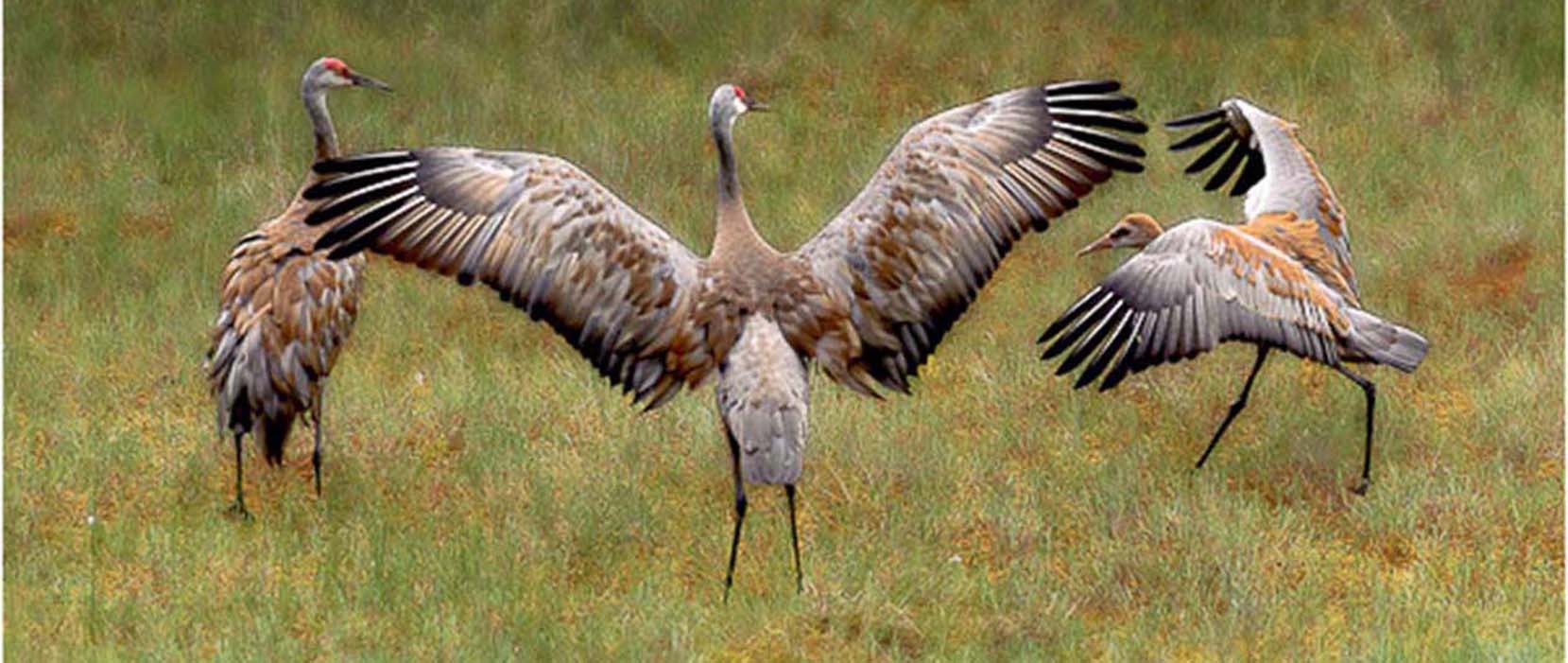
Millie (left), Roy (center) and Jacques wing-spread.

Millie (top) is swoops toward Roy in a Run-flap-glide, a rare high intensity female display.
On April 22 - Millie and Roy returned to the pond and danced on the ice on Earth Day. For the next two weeks, they danced, mated, and explored the pond margins and their creanberry bog as well as the ponds and marshes within a mile radius. .
By early May, Roy frequently piled a few grasses in tentative nestbuilding attempts that Millie gently inspected. In the photo, the pair is scrutinizing a nest site as they begin their final nest.
Millie began to incubate on May 5. Twin colts hatched 30 days later - Lucky on June 4 and Chance on June 5. For the next two weeks, the colts and family foraged, including two half-day walkabouts through the boreal forest to surrounding bogs.
On the morning of June 19, we saw only Lucky, the larger twin. We don't know what happened to Chance.
.In July, Lucky learned to forage, danced with her parents, and began pre-flight training.
Lucky's first flight was on August 6, earlier than for most other colts. In the weeks thereafter, she flew on day-trips across the valley and took several overnight excursions with her parents.
The family departed for migration on August 30, 2010.

Nestbuilding on May 5th

Lucky and Chance on June 14th
Millie and Roy returned on April 26th 2011 and followed their usual pattern of dancing, foraging, mating, and exploring. Roy made starter nests and on May 6th Millie joined in, laid an egg, and began incubation.
Early on the morning of May 16th, we were awakened by vigorous barking of our sled dogs. The cause of the dog's excitement was Roy - using Droop-wing Threat displays to herd a red fox aaway from the territory (see video).
On June 8th, we spied a colt: "Hastings", named after an ongoing forest fire in Interior Alaska. On the next day, Roy, Millie, and Hastings walked 3/8 mile to a neighbors' pond, then stayed for two nights there, and finally returned to our cranberry bog on June 11th.
Hastings was precocious. On July 5th, he presented a Droop-wing Threat display toward a squirrel. Also on that day, he began to dance with his parents. In his initial dance attempts, he fell down (see "One month old Sandhill" video) and remained a little timid for the next week but resumed dancing and flight school practice with vigor.
Hastings fledged on August 9th and for the rest of the month, he flew across Goldstream Valley on excursions with Millie and Roy. These short trips lasted an hour or longer and sometimes even overnight. Hastings was a very independent colt, giving Droop Wing Displays to squirrels, helping Millie and Roy harass an owl who had killed a duck (see 3rd video Owl Hastings) and often foraged by himself.
On the afternoon of September 1st, the family flew across Goldstream Valley and began to spiral up, riding thermals. Christy counted at least 30 rotations as they ascended higher and higher until they glided over the ridge to the south, toward Fairbanks. We thought that perhaps this was an early departure on migration, but at 5:10 pm, the family was back, foraging in Bog Central. They migrated two days later.
Roy confronts a red fox.
Hastings falls during dance.
Millie and Roy returned on May 1st to dance, to forage, to explore the territory, and to mate. For the first few nights, they roosted across the valley but after May 6th, they spent nights here. Roy tested nestbuilding at sites all across the marsh.
In the first week, several other cranes pairs and single cranes tried to settle here, including one who closely resembled Hastings-11, their colt of last year.
Millie laid her first egg in the evening of May 8th and began incubation at a nest site very near that of the last few years.
On May 9th, a lone intruder (Hastings?) appeared. Millie came off the nest and Roy chased the intruder into the valley. After 11 minues off the egg, Millie returned to incubation duty. In the following days, the intruder reappeared several times but he was ejected from both our cranberry bog and also the "Upper Pond" which is a half-mile to the west. [See map at the bottom of our Goldstream Local Ecology web page]
Perhaps the total home territory claimed by crane pairs is larger than the vicinity of the nest?
The eggs should have hatched on June 8th, but instead heavy rains fell and we saw no colts. Incubating stopped two days later. But then, both cranes began to pile marsh grasses and underwater weeds from the mucky bottom of the pond onto the nest. This piling continued until on June 14th. By then, the vegetation mound was almost one foot high. This pile caught the attention of ravens, perhaps because it was odorous?
For the next two weeks, crane behaviors seemed normal as Roy and Millie foraged, called frequently to other cranes in the valley, and danced with gusto. But on June 27th, they both started to lose their primary wing feathers until they became flightless for several weeks. We know of no similar report of flightless Sandhill Cranes in the scientific literature.


Spring 2013 was cold and snowy in Interior Alaska. Millie and Roy returned to their nest territory on May 8th and started incubation on May 17th. A single colt whom we named " Pi ", hatched on June 16th (Father's Day). The second egg did not hatch.
At first, Pi seemed reluctant to wander far from the nest. Roy defended Pi from ducks but Millie did most of the feeding. On Pi's first night, Roy went back to incubate the unhatched egg while Millie slept nearby, brooding Pi under her wings.
On June18th, Pi followed his foraging parents to bog central (see aerial view of nest territory ). Over the next 80 days, both parents were highly attentive: protecting and nurturing Pi and teaching him how to forage, to fly, to dance, and to be social.
Many of the episodes of Pi's first summer is presented in The Early Life of Pi on this website.Still photographs of Pi's early dancing can be seen on our Facebook page.
1- Return Home [Week 1]
2- Explore and Dance [Week 1]
3-Incubation [Weeks2-6]
4-Dancing on Ice [Week 2]
5-Pi forages [Weeks 6-7]
6-Dance coaching [Weeks 7-11]
6-Dance coaching [Weeks 7-11]
7-Threats & Danger [Weeks 5-13]
8-Dragonflies [Weeks 8-13]
9-Ground School [Week 9]
10-Swimming [Week 13]
11-Dance & Fly [Weeks 15-17]
12-Flight School [Weeks 13-17]
13-August Intruders [Weeks 14-17]
14-Pi's curiosity [Weeks 15-16]
15-Time to migrate [Weeks 17-18]
Millie and Roy returned on May 4th and began incubation on May 12th, but the eggs did not hatch. They foraged and danced often during the summer (see video) and then departed on migration on August 29th.
Roy and Millie dance in mid-summer.
On 26 April (Sunday), Steve DuBois reported a very large mass of cranes passing westward through Delta, Alaska and heading toward Fairbanks. At 6:15 am on the next day crane unison calls woke us from a sound slumber. We found Roy and Millie standing in "Bog Central", calling with high excitement. They cautiously explored the nest territory for 18 minutes and then flew across the valley to their alternate site, returning in the afternoon to inspect, to dance, to snooze standing in meltwater pools, to mate, and then across the valley for the night. Several other crane pairs returned to Fairbanks on Monday, one to a habitual nest territory near Chena Pump Road in Fairbanks and another pair north of Fairbanks.
On 28 April (Tuesday) the cranes spent the late morning foraging and inspecting. Roy made "starter nests" as they walked across the marsh. After a few hours across the valley, they were back at 7 pm to dance, preen, explore, and sleep for a while until they flew calling across the valley at 11:30 pm. Other cranes in the valley answered their calls.
Incubation began on May 4th. One colt ("Arrow") hatched on June 6th and after a typical first summer spent learning to forage, dance, and fly, she flew south with her parents in September.
Millie and Roy returned from migration on April 22. They spent the next week dancing, foraging and mating (several times). As they walked the territory, Roy piled cattail stalks in "starter nests" that Millie ignored at first. Then on May 6, they began incubation at the east end of their territory near the outlet of the pond.
Crane eggs should hatch in 30 days. Incubation began on May 6th, 2016, but the eggs did not hatch on June 5th. In spite of the hatch failure, Millie and Roy continued to incubate night and day into mid-July. We suspect that the embryos drowned when the nest was flooded during the heavy rains of mid-May 2016.
On evenings while Millie was incubating, Roy stood in Bog Central and called. Sometimes, he was answered by a pair of cranes across Goldstream Valley. Whether or not he wass answered, Roy frequently flew out across the valley and then all three cranes called back and forth. The conversations between Roy and the cross-valley pair suggest that there is local social structure among cranes in the valley. Perhaps the cross-valley crane pair includes one of Roy and Millie's colts from previous years?
Please email us if you know of any similar local crane "groupies".
Roy and Millie return for their 22nd year.
Millie and Roy did not return in the spring of 2017.
We live on 40 acres of permafrost near Fairbanks, Alaska.
For 24 years, Christy Yuncker Happ has recorded the passing of the seasons in her written journals, still images, and videos.
George Happ is responsible for this website and the Alaska Sandhill Crane Blog.
Christy Yuncker Happ
We welcome your emails
and your crane stories.